Chronograph
-
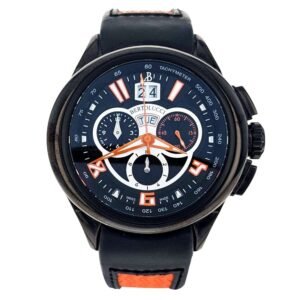
Bertolucci Forza II Chronograph 42mm 1393.50.42.1L18D.41L
$2,950$2,065 Add to cart -
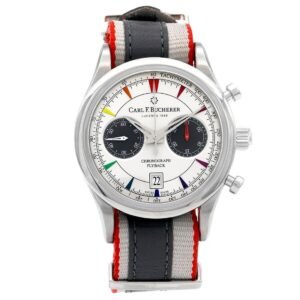
Carl F Bucherer Manero
$6,325$4,427.50 Add to cart -
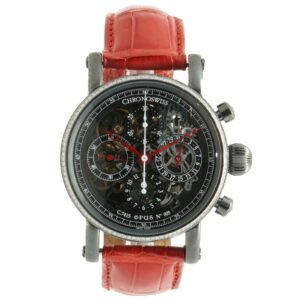
Chronoswiss Stainless Steel Chronograph Skeleton
$7,850$5,495 Add to cart -
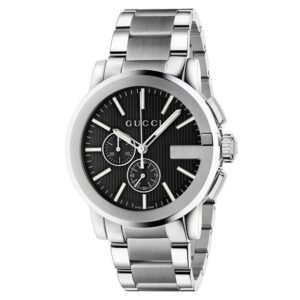
Gucci G-Chrono 44mm Quartz 393106
$2,300$1,610 Add to cart -
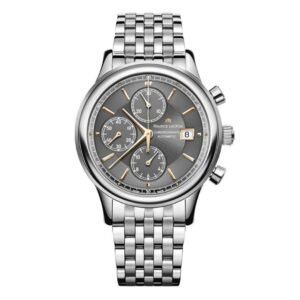
Maurice Lacroix Les Classique Chronograph 41mm LC6158-SS002-330-1
$2,900$2,030 Add to cart -
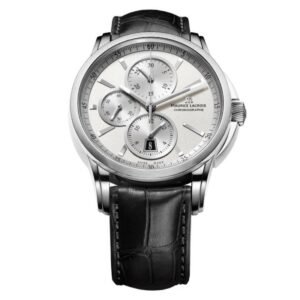
Maurice Lacroix Pontos Chronograph Automatic 43mm PT6188-SS001-130
$3,980$2,786 Add to cart -
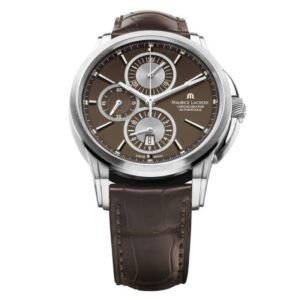
Maurice Lacroix Pontos Chronograph Automatic 43mm PT6188-SS001-730
$3,980$2,786 Add to cart -
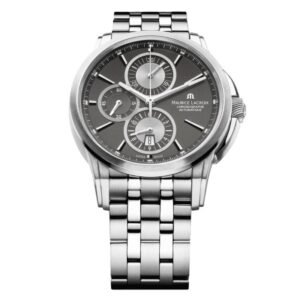
Maurice Lacroix Pontos Chronograph Automatic 43mm PT6188-SS002-830
$3,980$2,786 Add to cart -
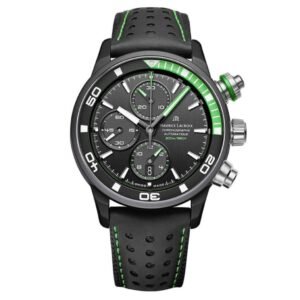
Maurice Lacroix Pontos S
$5,900$4,130 Add to cart -
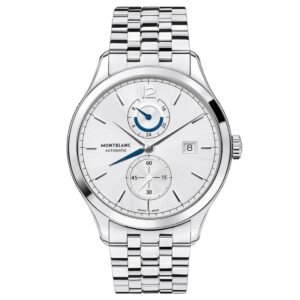
Montblanc Heritage Chronometrie
$4,500$3,150 Add to cart -
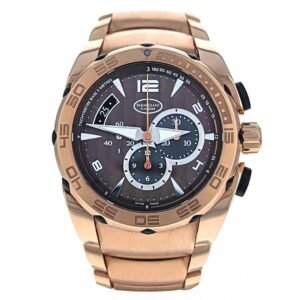
Parmigiani Fleurier Pershing
$62,500$43,750 Add to cart -
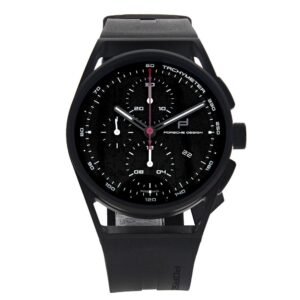
Porsche Design 1919 Chronotimer Chronograph 41.5mm Titanium 6020.1.02.003.06.2
$6,000$4,200 Add to cart
A chronograph is a watch with a stopwatch built into it: pushers start, stop and reset a sweeping seconds hand while subdials count the minutes and hours that have elapsed. BeepWear lists 25 pre-owned chronographs, from $2,300 to $62,500, with the middle of the range near $4,850 and most cases between 41mm and 44mm.
How does a chronograph work? The pushers, usually at two and four o’clock, drive a gear train separate from the one keeping time. The top pusher starts and stops a sweeping seconds hand, the subdials accumulate elapsed minutes and hours, and the lower pusher returns all three to zero. The watch keeps normal time throughout, which is the whole point: you are adding a stopwatch without giving up a watch. A flyback chronograph adds one refinement, resetting and restarting from a single press rather than requiring stop, reset and start in sequence, which is why the complication came out of aviation.
What is the difference between a chronograph and a chronometer? They are unrelated despite the similar names, and the confusion is common enough to be worth stating plainly. A chronograph is a stopwatch function you operate with pushers. A chronometer is an accuracy certification, awarded after a movement passes independent timing tests over several days in multiple positions and temperatures. A watch can be a chronograph, a chronometer, both, or neither, and the two words tell you nothing about each other.
Which chronographs are in stock? Maurice Lacroix leads with 5 pieces, including 4 from the Pontos line. Zenith follows with 4, among them an El Primero and a Defy. Seiko contributes 4 Prospex chronographs, Porsche Design 2 Chronotimer references in titanium, and TAG Heuer 2, including a Carrera. Chronoswiss, Zannetti and Montblanc round out the listing. Cases run 41 to 44mm and prices from $2,300 to $62,500, so the spread covers robust everyday Swiss and Japanese chronographs as well as high-beat and skeletonised pieces.
What kinds of chronograph movement are there? Three distinctions matter when you are comparing listings. First, integrated versus modular: an integrated chronograph is designed as one movement, usually thinner and better finished, while a modular chronograph adds a stopwatch module on top of a base movement, which is more common and easier to service. Second, column wheel versus cam: a column wheel gives the pushers a smoother, crisper feel and costs more to make, while a cam-actuated design is more robust and less expensive. Third, the power source: a mechanical chronograph is wound by hand or by rotor, while quartz and meca-quartz chronographs use a battery, with meca-quartz giving you a mechanical snap on the reset. None of these is simply better than the others, but they explain most of the price differences between two watches that look alike.
What does the price range cover? Twenty-one of these watches sit between $2,000 and $10,000, one falls between $10,000 and $25,000, and three sit above $25,000. The main band is where most usable Swiss and Japanese chronographs live, and it is the sensible place to start if this is a first chronograph. The pieces above $25,000 are there for movement finishing, scarcity or precious metal rather than for extra function, and they will not time a lap any better than the ones below them.
What do people actually use a chronograph for? Honestly, most owners use it rarely, and that is fine: the complication is bought for the dial, the pushers and the engineering as much as for the function. When it does get used it is for the small things, timing a run, a parking meter, a coffee brew, a lap. The one place a chronograph still beats a phone is when your hands are busy or wet and you want an elapsed time you can read at a glance without unlocking anything.
How do you read a tachymeter bezel? A tachymeter converts elapsed time into an average speed over a known distance, and it is the scale printed around the bezel or dial edge on many chronographs. Start the chronograph at the beginning of one mile or one kilometre and stop it at the end; whatever number the seconds hand points to on the tachymeter scale is your average speed in those units per hour: cover a kilometre in half a minute and the hand sits on 120, meaning 120 km per hour. Because the scale is a simple reciprocal it only works for events between roughly 7 and 60 seconds, which is why the numbers crowd together at the top of the dial. The same trick measures production rate: time one unit, and the scale reads units per hour.
What should you check on a pre-owned chronograph? Run the chronograph through a full cycle before anything else. Start it, stop it, reset it, and watch whether all three hands return exactly to zero; a hand that settles a fraction past the marker means the chronograph needs adjustment, which is routine but should be priced in. The pushers should feel consistent rather than mushy or gritty. Check that the subdial hands line up with their markers at rest. Look across the crystal at an angle for hairlines, and ask when the movement was last serviced, because a chronograph has more moving parts than a time-only watch and shows neglect sooner.
Do chronograph pushers need special care? On a water-resistant watch, yes. Screw-down pushers have to be locked before the watch gets wet, and the stopwatch should not be operated underwater unless the maker explicitly says otherwise, because pressing a pusher under pressure is a direct route to letting water in. Leaving the chronograph running continuously also adds wear to the parts it drives, which is why most makers suggest using it rather than treating it as a permanent seconds hand.
How often does a chronograph need servicing? The usual interval is every 5 to 10 years depending on the maker, the same as any mechanical watch, but a chronograph costs more to service because there is more inside it to clean, oil and adjust. A watch used as a stopwatch daily will want attention sooner than one whose pushers are rarely touched. A recent service record on a listing is worth real money, and its absence is worth asking about.
How does BeepWear list and ship these? Every watch is pre-owned, inspected before listing, and photographed as the actual item you will receive. Stock is one of a kind, so a sold listing comes down rather than lingering. Orders ship insured within the United States, and the authenticity guarantee, returns policy and warranty terms each have their own page.