Rolex Explorer
-
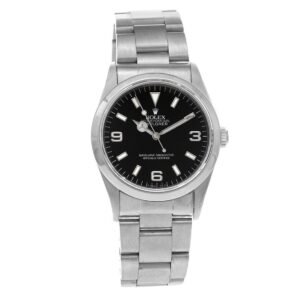
Rolex Explorer 36mm Stainless Steel 14270
$7,590$5,313 Add to cart -
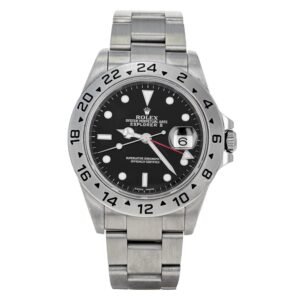
Rolex Explorer II 40mm Stainless Steel 16570
$9,500$6,650 Add to cart -
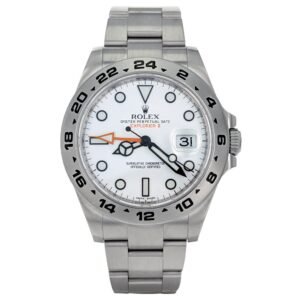
Rolex Explorer II 42mm Stainless Steel Polar 216570
$15,500$10,850 Add to cart -
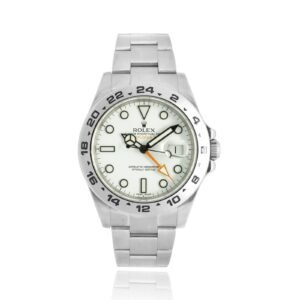
Rolex Stainless Steel Explorer II 42
$15,800$11,060 Add to cart -
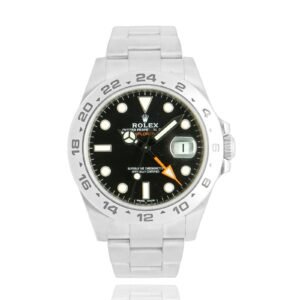
Rolex Stainless Steel Explorer II Black Dial 42mm
$12,500$8,750 Add to cart -
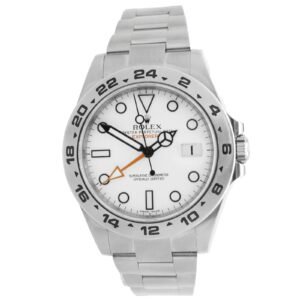
Rolex Stainless Steel Explorer II New Style Polar Dial
$15,500$10,850 Add to cart
The Rolex Explorer is the plainest Rolex sports watch, a black dial with 3, 6 and 9 numerals built for legibility, and the Explorer II adds a fixed 24-hour bezel and an orange hand for telling day from night. BeepWear lists six pre-owned Explorers and Explorer IIs, all in steel, from $7,590 to $15,800 with a median of $14,000. Each is inspected before listing and photographed as the actual watch.
Which Explorer references are in stock? One Explorer, the 36mm 14270 that Rolex made from 1989 to 2001 with a sapphire crystal and applied numerals. Five Explorer IIs: a 40mm 16570 from the same era, and four 42mm watches, a 216570 with the white Polar dial, a 216570 with the black dial, and two of the current-style 42mm Explorer II, one with the Polar dial. Every one is stainless steel, which is the only metal the Explorer has ever been made in.
What does a pre-owned Explorer cost? The 36mm 14270 is $7,590 and the 40mm 16570 Explorer II is $9,500, the two under $10,000 here and, in the whole Rolex sports range, close to the cheapest way into a five-digit reference. The 42mm Explorer IIs run from $12,500 for the black dial to $15,500 and $15,800 for the Polar dials and the newer-style watches. There is no gold and no precious metal on this page, so the spread is almost entirely age and generation.
Explorer or Explorer II? The Explorer, from 1953, is a time-only watch: no date, no bezel, 36mm on the 14270 and 36 or 40mm in the current line. The Explorer II, from 1971, was designed for cave explorers who could not see daylight: it adds a date, a fixed 24-hour engraved bezel and a separate 24-hour hand, in orange on the modern watches, so you can read whether it is 6am or 6pm. Since 2011 it is 42mm. The 24-hour hand on the 16570 and 216570 also sets independently, so it works as a second time zone in the same way as a GMT-Master.
What is a Polar dial? The white dial of the Explorer II, named for the arctic association; the black dial is the other option. Polar dials have black-outlined hands and indices for contrast and are, on the current market, the more sought after of the two. Two of the 42mm watches here have it. The 16570 was made with both dials as well.
Is the Explorer a good first Rolex? It is the one most often recommended as such, and the 14270 in stock is the classic reason: a 36mm steel Rolex with a chronometer movement, no date to set, no bezel to catch, and the same Oyster case as the rest of the line, for under $8,000. It is also the Rolex that draws the least attention, which for many owners is the point.
What should you check before buying a pre-owned Explorer? On the 14270 and 16570, whether the dial is original, because both were made across dial variations that collectors price differently, and whether the lume has been redone. On the Explorer II, that the 24-hour hand lines up with the bezel and that the date changes around midnight. And on all of them the bracelet: these were bought to be worn, and stretch in an Oyster bracelet from the 1990s is normal and negotiable.
How does BeepWear list and ship these? Every Explorer is pre-owned, inspected before listing, and photographed as the actual item you will receive. Stock is one of a kind, so a sold listing comes down rather than lingering. Orders ship insured within the United States, and the authenticity guarantee, returns policy and warranty terms each have their own page.