GMT
-
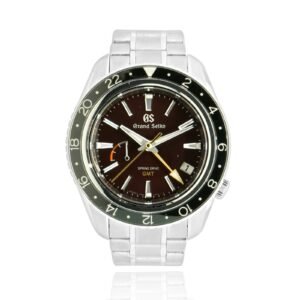
Grand Stainless Steel Spring Drive GMT 44mm
$5,700$3,990 Add to cart -
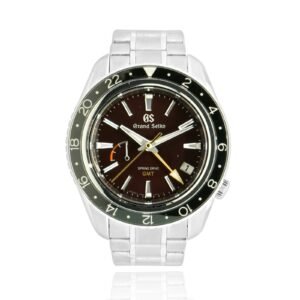
Seiko Grand Stainless Steel Spring Drive GMT 44mm
$5,700$3,990 Add to cart -
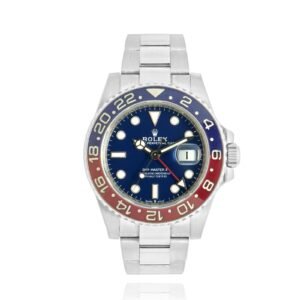
Rolex 18 Karat White Gold GMT Master II “Pepsi” 2023
$42,000$29,400 Add to cart -
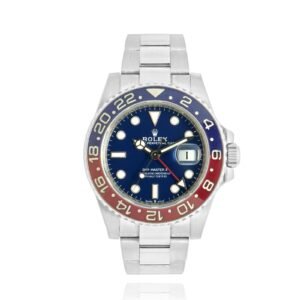
Rolex 18 Karat White Gold GMT Master II “Pepsi” 2023
$42,000$29,400 Add to cart -
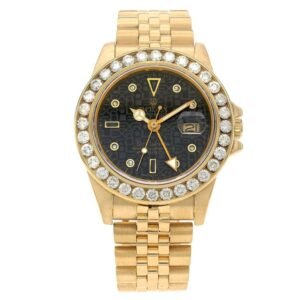
Rolex GMT-Master 40mm Yellow Gold 16758
$41,975$29,382.50 Add to cart -
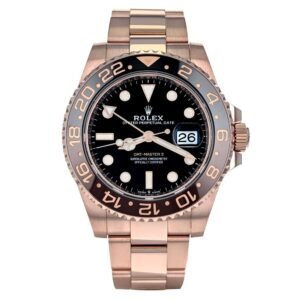
Rolex GMT-Master II 40mm Everose Gold Root Beer 126715CHNR
$52,000$36,400 Add to cart -
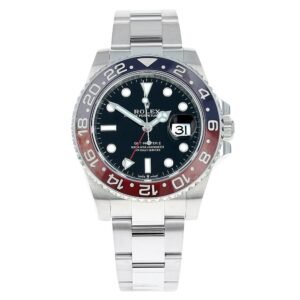
Rolex GMT-Master II 40mm Stainless Steel 126710BLRO
$24,750$17,325 Add to cart -
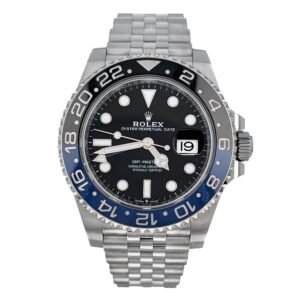
Rolex GMT-Master II 40mm Stainless Steel Batgirl 126710BLNR
$22,900$16,030 Add to cart -
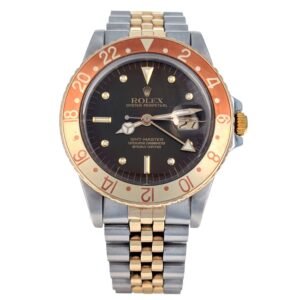
Rolex GMT-Master Stainless Steel Yellow Gold Root Beer 16753
$13,800$9,660 Add to cart -
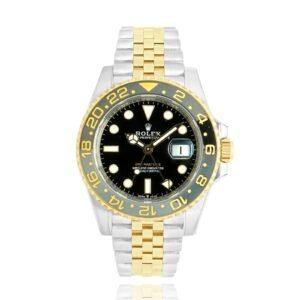
Rolex Stainless Steel & 18 Karat Yellow Gold GMT Master II “Zombie”
$25,000$17,500 Add to cart -
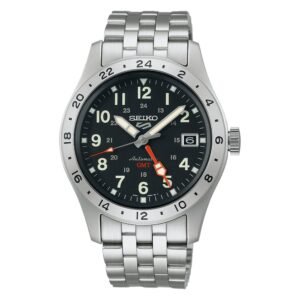
Seiko 5 Sports Field GMT Stainless Steel SSK023
$450$315 Add to cart -
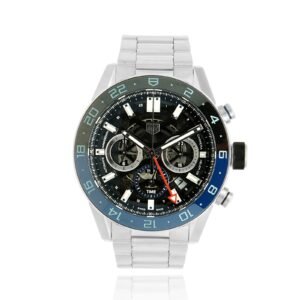
TAG Heuer Carrera GMT
$4,850$3,395 Add to cart
A GMT watch is a watch that shows a second time zone on a fourth hand, read against a 24-hour scale. There are 13 in stock here, priced from $450 to $52,000 with a median of $22,900. Eight of them are Rolex GMT-Masters or GMT-Master IIs, which is roughly the shape of the market itself: Rolex built the category and still defines it. The rest are a Tudor Black Bay GMT, two Grand Seiko Spring Drive GMTs, a TAG Heuer Carrera that combines the complication with a chronograph, and a Seiko 5 Field GMT. The prices are not evenly spread: three pieces sit under $5,000, three between $5,000 and $15,000, three between $15,000 and $30,000, and four above $30,000. That gap in the middle is worth knowing about before you start, because it is the difference between a working traveller’s watch and a gold Rolex. Everything below is written from the stock actually listed on this page.
What makes a watch a GMT? A fourth hand that circles the dial once every twenty-four hours instead of every twelve, read against a twenty-four-hour scale. Because it takes a full day to go around, there is no morning-or-evening ambiguity: if it points at 18, it is six in the evening wherever you have set it. The ordinary hour hand keeps doing its ordinary job, so you get two zones from one dial without two watches. Rolex built the first one in 1955 for Pan American World Airways, whose crews had begun flying routes long enough that home time and local time were meaningfully different, and the layout has barely changed since. Everything that has changed since is about how you set it.
What is the difference between a true GMT and a caller GMT? Which hand moves when you adjust the watch. On a true GMT, sometimes called a flyer, the local hour hand jumps forward or back in one-hour steps on its own, the date follows it, and the twenty-four-hour hand stays put on home time. You land, you move the local hand, you are done, and the watch never stops. On a caller GMT the opposite is true: the local time is fixed to the main hands and you set the twenty-four-hour hand independently instead. That suits someone who stays put and tracks a zone somebody else is in, which is where the name comes from. Neither is better in the abstract. A true GMT is worth paying for if you actually cross zones; a caller costs less and does the desk job just as well. In this collection the Tudor Black Bay GMT and the Grand Seiko Spring Drive GMTs set their local hour hands independently, and the Seiko 5 Field GMT sets its twenty-four-hour hand instead. Rolex moved the GMT-Master to an independent local hour hand in the early 1980s, which is when the model became the GMT-Master II.
How do you read a twenty-four-hour bezel? The bezel is what turns two time zones into three. With it lined up at twelve, the twenty-four-hour hand reads home time straight off the fixed scale. Rotate it, and the same hand reads against the offset instead: turn the bezel three hours and the hand now shows a third zone without the movement being touched at all. It costs you nothing and you can undo it in a second, which is why the feature has survived seventy years of redesign. The cheaper trick it also enables is timing: line the bezel up with the hour hand and you have a very coarse elapsed-time reading, though a diver’s sixty-minute bezel does that job far better.
What is the difference between a GMT and a world timer? How many zones you get and how much watch it takes to show them. A GMT gives you two zones, or three with the bezel, using one extra hand and no extra thickness. A world timer shows all twenty-four at once, by rotating a ring of city names against a twenty-four-hour ring, an arrangement Louis Cottier worked out in the 1930s and which almost every world timer since has copied. The world timer wins on coverage and loses on everything else: it is thicker, costs considerably more, crowds the dial to the point where reading the local time takes a moment, and its city ring assumes whole-hour offsets, so zones on a half-hour offset like India do not fit it properly. For most people who genuinely need a second zone rather than all of them, a GMT is the better instrument. There are no world timers in this collection.
Is GMT the same as UTC? Not quite, and the difference occasionally matters. GMT is a time zone, the one on the Greenwich meridian. UTC is a time standard, kept by atomic clocks, which the world synchronises to and which aviation uses under the name Zulu. In daily use they are within a second of each other, so the distinction rarely bites. The one that does bite is daylight saving: GMT does not observe it, but the United Kingdom does, so for half the year London is on British Summer Time and is an hour ahead of GMT. If you set your twenty-four-hour hand to London rather than to GMT, it will be wrong from late March to late October. The complication kept the name for historical reasons; what it actually tracks is whatever zone you set it to.
Which GMT watches are in stock right now? The Rolexes cover both eras. From the current generation there is a 126710BLRO in steel with the red and blue bezel, a 126710BLNR in steel with blue and black, a 126715CHNR in Everose gold with brown and black, and a pair of white gold GMT-Master IIs from 2023. Older ones include a yellow gold 16758 and a steel and yellow gold 16753 from the aluminium-bezel years, plus a two-tone GMT-Master II in steel and yellow gold. Outside Rolex: the Tudor Black Bay GMT 79830RB at $4,083, two Grand Seiko Spring Drive GMTs at 44mm and $5,700, a TAG Heuer Carrera GMT chronograph at $4,850, and a Seiko 5 Field GMT SSK023 at $450. Stock is one of a kind, so this list is accurate only as long as the pieces are still on the page.
What do Pepsi, Batgirl and Root Beer mean? They are collector shorthand for bezel colours, not Rolex’s own names, and nobody at Rolex will use them with you. Pepsi is the red and blue bezel that has been on the model since 1955. Batman and Batgirl are both the blue and black bezel, distinguished by bracelet: Batman on the Oyster, Batgirl on the Jubilee, which is why the 126710BLNR here is listed as a Batgirl. Root Beer is the brown and black or brown and gold combination, worn by both the modern Everose 126715CHNR and the 1980s steel-and-gold 16753 in this collection. The suffixes are real, though: BLRO, BLNR and CHNR are Rolex’s own codes, built from the French colour names.
What does a pre-owned GMT-Master II cost? In this collection, the steel references sit in the low-to-mid twenty thousands, with the Batgirl at $22,900 and the Pepsi at $24,750. Precious metal roughly doubles it: the Everose Root Beer is $52,000, the yellow gold 16758 is $41,975, and the white gold pieces are $42,000 each. The two-tone GMT-Master II is $25,000 and the older steel-and-gold 16753 is $13,800. If the Rolex numbers are not where you want to be, the same complication is available here from $450, and the $4,000 to $6,000 band is where the Tudor, the TAG Heuer and the Grand Seikos live. That is the single most useful thing to know about GMT shopping: the function is cheap, the name is not.
How do the 1980s GMT-Masters differ from the current ones? Three things matter. The bezel insert on the older references is anodised aluminium, which scratches and fades, and a faded insert is either a defect or the entire appeal depending on who you ask — it is priced accordingly and it cannot be undone. Rolex moved to a ceramic insert that does not fade, with the two-colour version arriving in 2013 and the steel red-and-blue in 2018. Second, the movements: the current 126710 generation runs Rolex’s 3285 calibre with a roughly seventy-hour reserve, where the 1980s references have a far shorter one, so a watch left off overnight behaves differently. Third, originality becomes a value question on the older pieces in a way it is not on the newer ones. A replaced dial, hands or insert on a 16758 changes what it is worth; the same swap on a 2023 watch is simply a repair.
Is a GMT useful if you never fly? Often, yes, and this is under-appreciated. The complication tracks any second zone, not just one you are travelling to: family somewhere else, a market that opens while you sleep, colleagues eight hours ahead. A caller GMT is designed for exactly that person. It is also the least intrusive of the useful complications — one extra hand, no subdials, no change to how you read the time at a glance — which is why GMTs get worn as everyday watches by people who never touch the second zone at all. If you genuinely want none of that, the money is better spent on a cleaner three-hand watch.
What size are these watches? They run from just under 40mm to 44mm. The Rolex GMT-Masters are all 40mm, which has been the model’s size for decades and is the reason it fits a wider range of wrists than most sports watches of its stature. The Tudor Black Bay GMT is 41mm, the Seiko 5 Field GMT is just under 40mm, and the two Grand Seiko Spring Drive GMTs are the largest here at 44mm. Bear in mind that a GMT dial carries a twenty-four-hour scale and a fourth hand, so it reads busier than a plain dial of the same diameter, and a bezel-equipped case wears larger than its number suggests.
What should you check before buying a pre-owned GMT? Confirm which setting behaviour it has, because the listing photograph cannot tell you and it changes how the watch works every single day. Check that the twenty-four-hour hand actually aligns with the scale and with the hour hand — a misaligned GMT hand is a common and irritating fault. Turn the bezel through a full rotation if you can: it should click evenly with no slack. On older references, ask what is original, specifically the insert, dial and hands. Ask when it was last serviced. And check that the date changes at midnight rather than at noon, which is the classic symptom of a watch that was set twelve hours out and has been running that way ever since.
How often does a GMT need servicing? Every five to ten years for most mechanical watches, and a GMT is not unusually demanding — the extra hand adds a gear train, not the hundred-odd parts a chronograph adds. The thing that does wear is the setting mechanism on a true GMT, because the jumping hour hand gets used hard by people who travel with it. A service record on a listing is worth real money and its absence is worth asking about, particularly on a watch from the 1980s that may have had a long quiet life in a drawer.
How does BeepWear list and ship these? Every watch is pre-owned, inspected before listing, and photographed as the actual item you will receive. Stock is one of a kind, so a sold listing comes down rather than lingering. Orders ship insured within the United States, and the authenticity guarantee, returns policy and warranty terms each have their own page.