Rolex Datejust
-
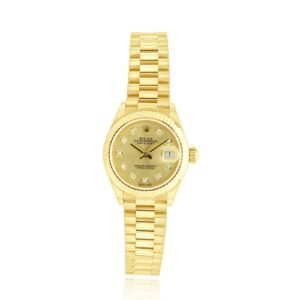
Rolex 18 Karat Yellow Gold Datejust 28mm
$38,000$26,600 Add to cart -
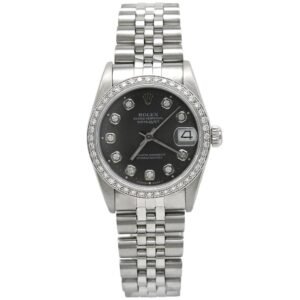
Rolex Datejust 31 Stainless Steel Diamonds 68240
$7,750$5,425 Add to cart -
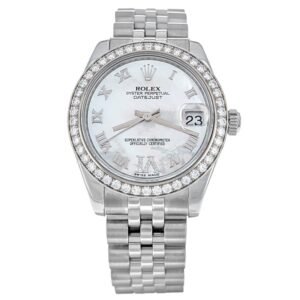
Rolex Datejust 31 Stainless Steel White Gold Diamonds 178384
$17,500$12,250 Add to cart -
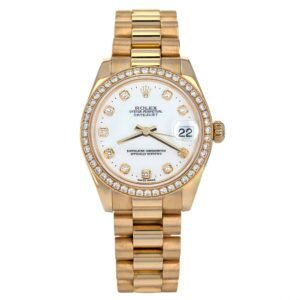
Rolex Datejust 31 Yellow Gold Diamonds President 178288
$39,500$27,650 Add to cart -
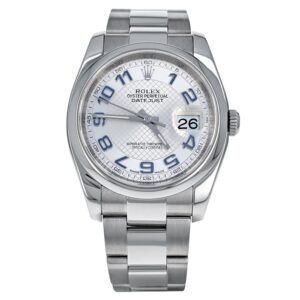
Rolex Datejust 36 Stainless Steel 116200
$8,000$5,600 Add to cart -
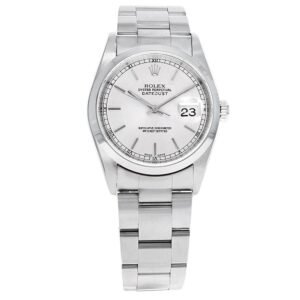
Rolex Datejust 36 Stainless Steel 16200
$7,130$4,991 Add to cart -
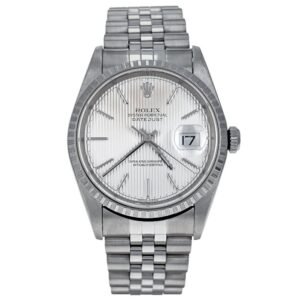
Rolex Datejust 36 Stainless Steel 16220
$6,900$4,830 Add to cart -
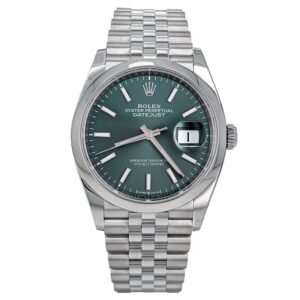
Rolex Datejust 36 Stainless Steel 2025 126200
$14,500$10,150 Add to cart -
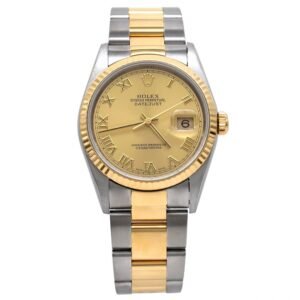
Rolex Datejust 36 Stainless Steel Yellow Gold 16233
$8,000$5,600 Add to cart -
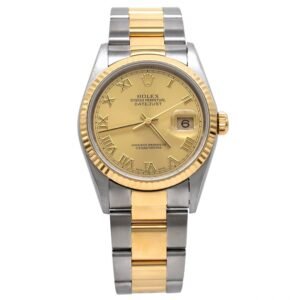
Rolex Datejust 36 Stainless Steel Yellow Gold 16233
$8,950$6,265 Add to cart -
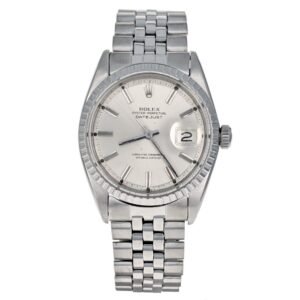
Rolex Datejust 36mm Stainless Steel 1603
$6,500$4,550 Add to cart -
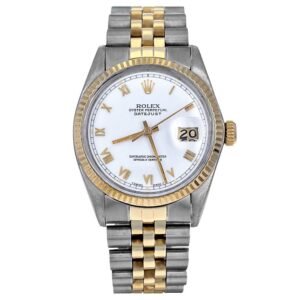
Rolex Datejust 36mm Stainless Steel Yellow Gold 16013
$7,900$5,530 Add to cart
The Rolex Datejust is the classic Rolex: a self-winding Oyster case with a date window, made since 1945 in more sizes, metals and dial combinations than any other Rolex line. BeepWear lists 36 pre-owned Datejusts, priced from $4,773 to $39,500 with a median of $13,400. Thirteen are under $10,000, seventeen sit between $10,000 and $20,000, and six are above $20,000. Every watch on this page is inspected before listing and photographed as the actual piece you receive.
Which Datejust sizes are in stock? All of them that matter. The Datejust 41 is the largest group with 13 pieces, including the current 126300, 126331, 126333 and 126334 references and the earlier Datejust II, which was Rolex’s 41mm answer between 2009 and 2016 before the slimmer Datejust 41 replaced it. The 36mm classic follows with 10, spanning the four-digit 1603 and 16013 of the 1970s and 1980s, the five-digit 16200, 16203, 16220 and 16233, the six-digit 116200 and a 2025 126200. Five are 31mm midsize references (68240, 178288, 178384 and two factory diamond-bezel pieces), two are 28mm and one is a 26mm Lady-Datejust 6917. There is also a 44mm Datejust II for the largest wrists.
What does a pre-owned Datejust cost? In this collection the entry point is a $4,773 two-tone Lady-Datejust, and steel 36mm references from the 1980s and 1990s sit between $6,500 and $8,000. A steel Datejust 41 with a plain dial runs $9,900 to $14,000; add a Wimbledon dial or a white gold fluted bezel and it moves to $14,900 to $21,900. Two-tone yellow gold 41s from 2025 are around $23,000, and the top of the page is a $39,500 31mm yellow gold President with factory diamonds. The median of $13,400 is a fair picture of what a good steel or Rolesor Datejust costs here.
Steel, two-tone or gold? Thirty-four of the 36 are steel-cased. Fourteen are Rolesor, which is Rolex’s word for a steel case and bracelet with a yellow, white or rose gold bezel and centre links; ten carry yellow gold, four white gold and two Everose. Seven have diamonds, and it matters where those came from: the two 31mm pieces are listed as factory diamond bezels, and the 41 that was set after purchase is listed as custom set, because the two are worth very different money. The white gold on a steel Datejust is almost always the fluted bezel, which Rolex only makes in gold.
What is the difference between a Datejust 36 and a Datejust 41? Five millimetres of case, and a decade of movement. The 36 is the original proportion and still the most versatile: it wears on almost any wrist and under any cuff. The 41 arrived in 2016 with the calibre 3235 and a roughly 70-hour power reserve, and it replaced the Datejust II, which was also 41mm but thicker and heavier. If you are between the two, the 36 in stock here is often the older and cheaper watch, and the 41 the newer one with the longer reserve; that gap, not the size, is usually what decides it.
What do the reference numbers mean? The first digits date the watch. Four digits such as 1603 are 1960s and 1970s production with acrylic crystals. Five digits beginning 16 (16013, 16200, 16220, 16233) run from the late 1970s to the early 2000s with sapphire crystals and quickset dates. Six digits beginning 116 or 126 are the modern watches. The last two digits describe the bezel and metal: 00 is a smooth steel bezel, 20 an engine-turned one, 33 or 03 is two-tone yellow gold, 34 is steel with a white gold fluted bezel. A 17013 is the rare Oysterquartz, Rolex’s own quartz movement in an angular case made from 1977 to 2001.
What is a Wimbledon dial? A slate grey dial with green Roman numerals, named by collectors after the tournament Rolex sponsors. Four Datejust 41s here carry it, on steel and on steel with a white gold bezel, from 2018 to 2024. It is one of the few Datejust dials that people search for by nickname, and prices in this collection run from $14,900 for the steel version to $21,900 for the white gold bezel.
Jubilee or Oyster bracelet? The Jubilee, the five-link bracelet Rolex designed for the Datejust’s launch, is the dressier and more flexible of the two; the three-link Oyster is sportier and holds its shape. On a pre-owned watch the bracelet is worth a close look: stretch between the links is normal on 20-year-old Jubilees and is priced in, and a bracelet that has been swapped from the original is a legitimate question to ask before buying.
What should you check before buying a pre-owned Datejust? Whether the date changes crisply around midnight, because a sluggish change is the cheapest early warning of a service being due. Whether the dial and hands are original to the reference, which matters most on the four- and five-digit watches. Whether a diamond bezel is factory or aftermarket. And when it was last serviced: Rolex suggests roughly every ten years, and a watch that has never been opened may be honest but will need money spent on it.
How does BeepWear list and ship these? Every Datejust is pre-owned, inspected before listing, and photographed as the actual item you will receive. Stock is one of a kind, so a sold listing comes down rather than lingering. Orders ship insured within the United States, and the authenticity guarantee, returns policy and warranty terms each have their own page.