Diamond Watches
-
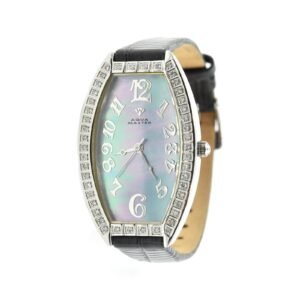
Aqua Master Watch
$400$280 Add to cart -
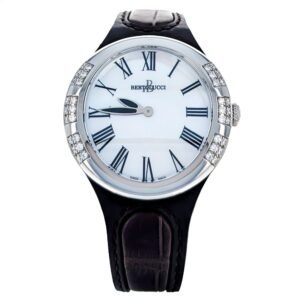
Bertolucci Serena Garbo 37mm Stainless Steel Diamonds 303.55.41P2.1BM
$4,950$3,465 Add to cart -
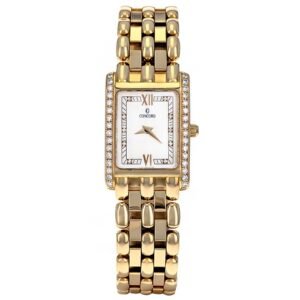
Concord Vento Yellow Gold Diamonds 51-25-665
$7,500$5,250 Add to cart -
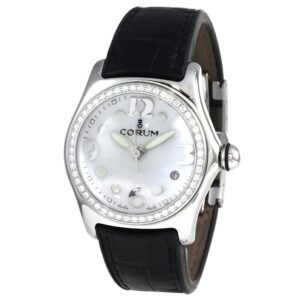
Corum Bubble 35mm
$4,150$2,905 Add to cart -
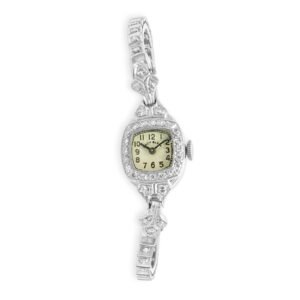
Elgin 14k White Gold Vintage Art Deco Diamond Ladies Manual Wind Watch
$1,600$1,120 Add to cart -
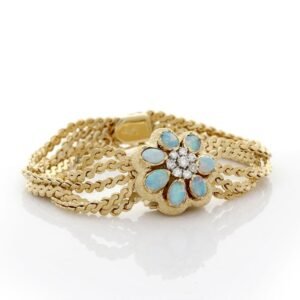
Eloga 14KY Gold Vintage Diamond Opal Flip Top Dress Watch
$2,645$1,851.50 Add to cart -
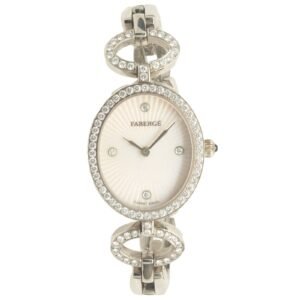
Faberge 18 Karat White Gold Diamond and Mother of Pearl Anastasia Dress
$17,900$12,530 Add to cart -
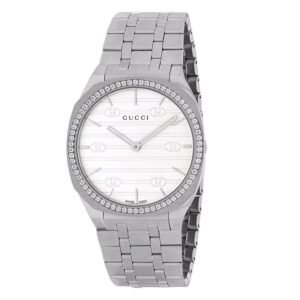
Gucci 25H's Streamline 34mm Diamond Bezel 673109
$4,500$3,150 Add to cart -
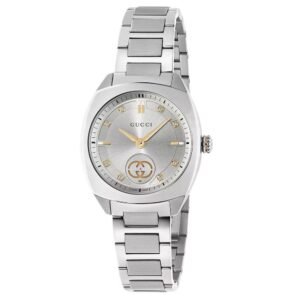
Gucci Interlocking G
$2,000$1,400 Add to cart -
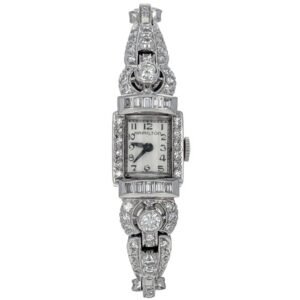
Hamilton Vintage Watch
$7,000$4,900 Add to cart -
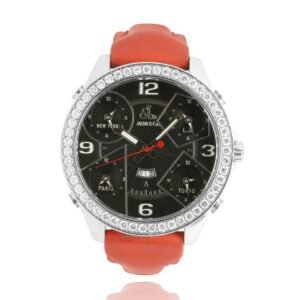
Jacob & Co. 5 Time Zone
$5,000$3,500 Add to cart -
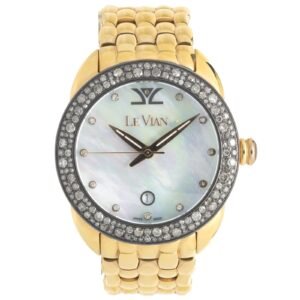
Levian Rose Plated Chocolate Diamond Ladies Watch
$2,295$1,606.50 Add to cart
Thirty-two diamond-set watches are listed here, and they cover a wider range than the phrase usually suggests: $400 to $64,500, with a median of $6,000. Fifteen are under $5,000, five sit between $5,000 and $15,000, seven between $15,000 and $30,000, and five are above $30,000. Rolex accounts for eleven of them, mostly Datejusts and Day-Dates, and the rest run from Piaget, Faberge and Jacob & Co at the top through Gucci, Corum, Concord and Maurice Lacroix in the middle to Tissot and Seiko below $2,000. Cases run from 26mm to 41mm. The single most important question on this page is not which watch but which kind of diamond setting, so that is where this starts.
What is the difference between factory-set and aftermarket diamonds? Who set the stones. A factory-set watch left the manufacturer with its diamonds already in place, cut and fitted to that case by the maker. An aftermarket or custom-set watch was plain when it was sold and had stones added later by a third party. The two can look similar in a photograph and are worth very different money. Factory settings hold value because they are part of the watch’s identity and its reference number; aftermarket settings generally do not, and in some cases reduce what the watch is worth below the plain version, because the case has been cut into. There is a practical consequence too: manufacturer service centres, Rolex’s included, may decline to work on a watch carrying non-original stones, or replace the altered part with a standard one. Neither kind is dishonest. What matters is that the listing says which it is. In this collection you can see the gap directly: the two factory-bezel Datejust 31s are $15,000 each, and the custom-set Datejust 41 is $20,600.
Which is which in this collection? The listings say so directly. Two Rolex Datejust 31s are described as having a factory diamond bezel, and one Datejust 41 is described as custom set — that is an aftermarket setting, named as one. Rolex’s own reference numbers carry the information as well: the RBR suffix on the Day-Date 228348RBR and 128348RBR denotes a factory diamond bezel, so those are original by definition. Where a listing does not say, ask before you buy, and expect a straight answer. A dealer who cannot tell you who set the stones has not examined the watch closely enough to be selling it.
Where are the diamonds actually set? Four places, in rough order of how much they cost. On the bezel, which is the most visible and the most common — most of the Rolexes here are bezel-set. On the dial, either as replacements for the hour markers or as a full pave surface covering the whole face. On the lugs and case sides, which is where heavily customised pieces go. And on the bracelet itself, which is the most expensive because of the sheer number of stones involved. Bezel and marker settings are the ones that commonly come from the factory; full case and bracelet work more often does not. The bezel-set Rolexes here run from a $7,750 Datejust 31 to a $64,500 Day-Date 40, and the Jacob & Co at $5,000 is a bezel setting too.
What does a diamond watch cost here? The bottom of the range is a genuine entry point rather than a token: four Seiko and Aqua Master pieces sit between $400 and $550, and a Tissot, a Gucci and a Le Vian fall between $1,900 and $2,295. From there the middle fills in with Raymond Weil, Maurice Lacroix, Corum, Bertolucci and Gucci between $2,380 and $4,950. Above $7,000 it becomes mostly Rolex, from a $7,750 Datejust 31 through a $17,000 Datejust 41 to the Day-Dates, which run from $25,000 to $64,500. The outliers are a $34,000 Piaget Limelight Gala and a $17,900 Faberge Anastasia. Half this catalogue is under $5,000, which is worth saying plainly because the category has a reputation for being out of reach.
What is a mother-of-pearl dial? The iridescent inner layer of a shell, cut thin and used as the dial surface. Two watches here have one, the Faberge Anastasia and the Aqua Master. Because it is a natural material, no two dials are identical and the colour shifts as the watch moves, which is the entire appeal. It is also softer and more fragile than a lacquered metal dial, so a mother-of-pearl watch deserves more care about knocks, and a damaged dial is expensive to replace rather than repair. The two here sit at opposite ends of the catalogue: the Faberge Anastasia at $17,900 and the Aqua Master at $400.
What are chocolate diamonds? Brown diamonds, marketed under a name Le Vian trademarked — the Le Vian piece in this collection is the one that uses them. They are real diamonds, graded on the same scale as colourless ones, sitting in the brown range that used to be sold as industrial stone before the marketing arrived. That history is why they cost less per carat than a colourless diamond of the same size and clarity, and why a chocolate-diamond watch can be genuinely well made and still affordable. The Le Vian piece here is $2,295. Judge it on how it looks, not on the name.
Are these watches only for women? No, though the catalogue leans that way and the older listings say so in their titles. The sizes tell the real story: the range here starts at a 26mm Philippe Charriol and a 29mm Gucci, but it also includes a 41mm Datejust and two 40mm Day-Dates, which are full-size watches by any current standard. The Day-Date in particular has been a men’s watch with a diamond bezel for its entire history. Size and setting are separate decisions, and this collection has both at both ends.
What about the vintage pieces? Several of the lower-priced watches here are genuinely old rather than merely used: an Elgin Art Deco manual-wind in 14 karat white gold, an Eloga flip-top dress watch in 14 karat yellow gold, a platinum Pery, and a Hamilton in platinum with diamonds and sapphires. These are bought on condition and originality rather than on specification, they generally need winding rather than wearing to stay running, and they are not water resistant in any useful sense. They are also the cheapest way into the category: the Elgin is $1,600, the platinum Pery $2,500, the Eloga $2,645 and the Hamilton $7,000. Treat them as jewellery that tells the time, which is what they were sold as.
What should you check before buying? Ask who set the stones, and get the answer in writing. Look closely at the setting itself in the photographs: factory work is uniform in stone size, spacing and depth, and hand-added work often is not. Check whether any stones are missing or loose, which on a bezel is both common and visible. Confirm the reference number matches the description. On quartz pieces — the Tissot, the Gucci Interlocking G and the Seikos are quartz — ask when the battery was last changed, since a watch battery typically lasts 2 to 3 years. And on anything vintage, ask whether it is running and when it was last serviced, because a beautiful watch that does not keep time is an expensive repair waiting to happen.
How does BeepWear list and ship these? Every watch is pre-owned, inspected before listing, and photographed as the actual item you will receive. Stock is one of a kind, so a sold listing comes down rather than lingering. Orders ship insured within the United States, and the authenticity guarantee, returns policy and warranty terms each have their own page.